
As of Fall of 2018 I am enrolled in a science fiction in cinema genre course. Occasionally I may write about films we have viewed and concepts that have stuck with me.
Why was “Things to Come” so brutally attacked in our class discussion? For a 1936 film, this picture does a great deal to advance our genre in terms of aesthetic values and, honestly, the narrative plot. Sure, the characters are hard to relate to or empathize with because they do not dominate the screen time like the big, action blockbusters of today, but I think the attempted message of seeking peace is a powerful one.
I claim that “Things to Come” has advanced our idea of narrative structure because of the way it broke down its runtime into three somewhat connected stories. While it sacrificed dramatic tension for a longer storyline, its experimental structure has stayed with us in science fiction film, most notably through “2001: A Space Odyssey.”
CONNECTIONS TO “2001, A Space Odyssey”:
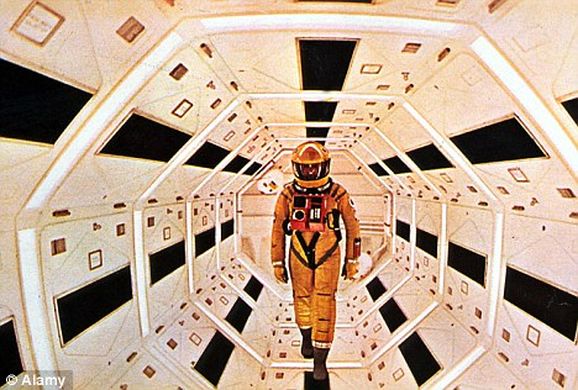
Why was our science fiction in cinema class so hyper critical of the loose narrative structure in “Things to Come,” yet they were so enthralled by Kubrick’s, “2001: A Space Odyssey?” In so many ways, Kurbick must have been inspired by this earlier film. The primary difference between the two films is the arc of technological progression. While Kubrick starts with primitive chimpanzees, hops into the distant future of space travel, and then follows Hal’s spacecraft, in “Things to Come” we start with a modern town, watch its decent into primitive chaos, and then jump into the future of space travel. Admittedly, “Things to Come” is more pessimistic in the way it believes humans desire a return to more primitive times: to escape technology in favor of the arts. However, both films ultimately send out a warning. While it’s a stretch, you could say they both share a warning against technology — but that’s the entire science fiction genre. No, instead I think “Things to Come” warns against war and complacency, while “2001” suggests that our technology can turn against us and that we have lost touch with our spirituality.
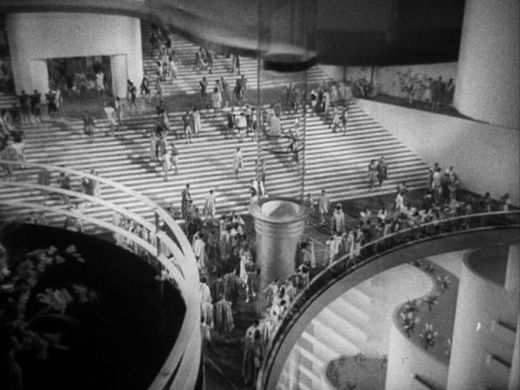
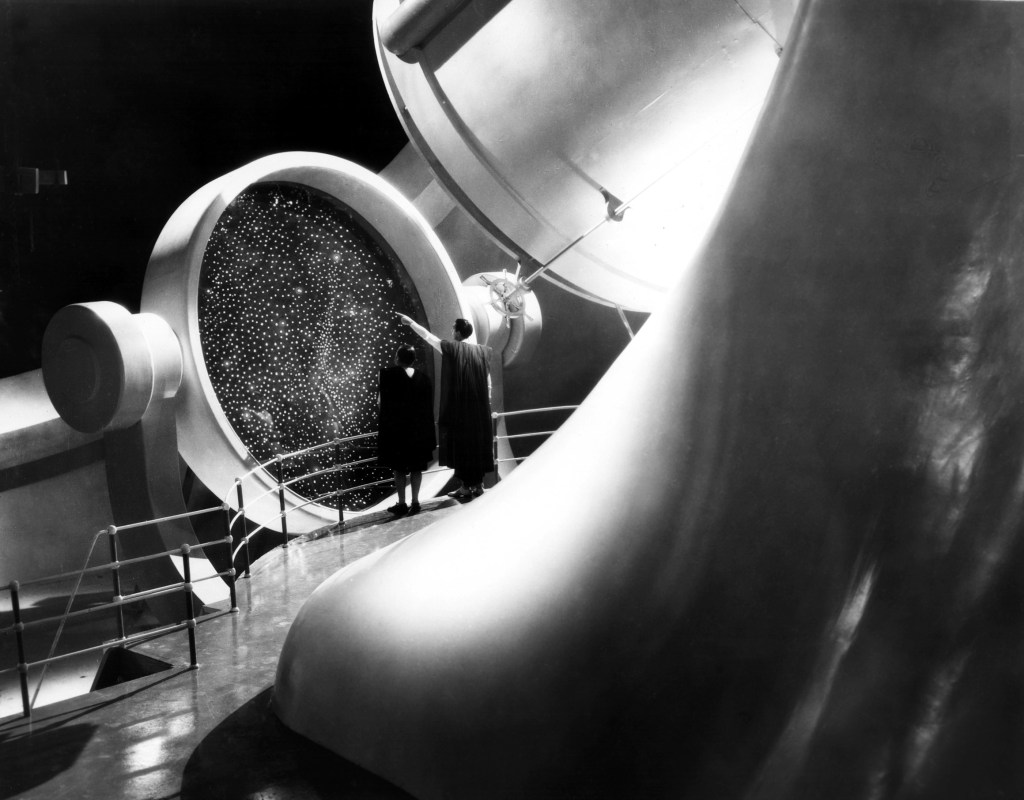
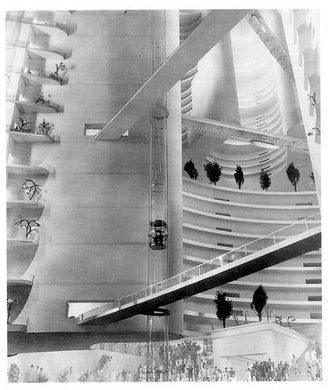
One of the most brilliant connections between the to films is how they design space travel. Both share the vision of Vincent Korda, the brother of the producer on “Things to Come.” “Things to Come,” in many ways, inspired the style we still associate with space travel and the future. His use of the color white was a strong one as it offers both a stark sterile-ness to space travel as well as an intense contrast against the natural world of Earth. Additionally, his use of circular pathways and curved, yet strong lines offers a certain feasibility to the physics of space while remaining some similarity and accessibility. In utter contrast, the monoliths in 2001 are large, harsh, black rectangular prisms. This model may act as a believable alien life force or totem because Korda had laid the foundation to recognize smooth white design as human space travel.
CONNECTIONS TO OTHER MEDIA:
So much of the beginning of this film felt like a Doctor Who Christmas special. We open on a perfect small town, “Everytown,” which is joyously celebrating Christmas in a time of war. Then, suddenly, the enemy attacks and the world is pushed into chaos. Sure, the Doctor Who special would have stayed in the chaos surrounding the town that night instead of telling a story in three parts over centuries — but I digress.
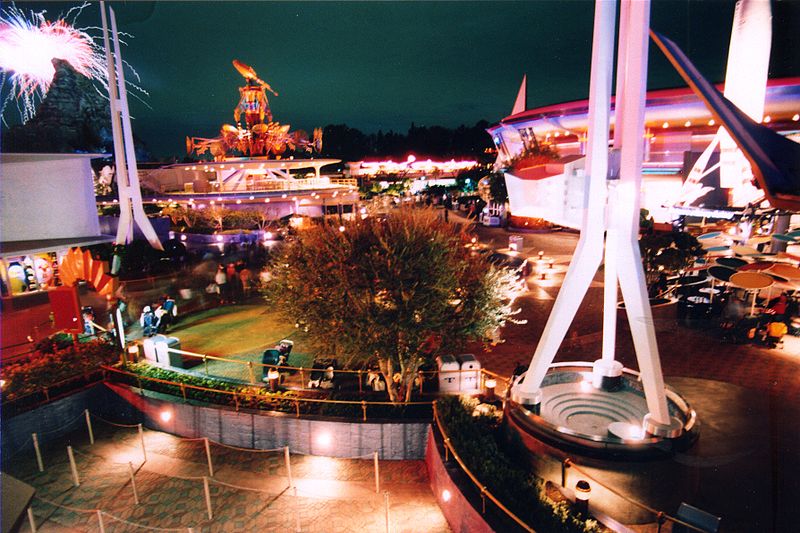
Another interesting connection is the design of space travel in this film and “Tomorrowland” at the Walt Disney Resorts. I can remember going to Walt Disney World as a child and being very taken out of the magic by the concrete plainness of “Tomorrowland.” Probably because when my family went in the mid-2000s I was desensitized to the sort of “modern” architecture the park was sporting. In many ways, the Tomorrowland section of “The Magic Kingdom” felt like a time capsule — its general aesthetic screamed “70s modern” as opposed to the future I saw on my children’s TV shows. That said, both of these styles shared their roots in the stark, “sterile,” and colorless smooth lines of Korda’s “Things to Come.”
 Jesseca Kusher
Leave a comment