
The chill hits my cheeks, burning them red.
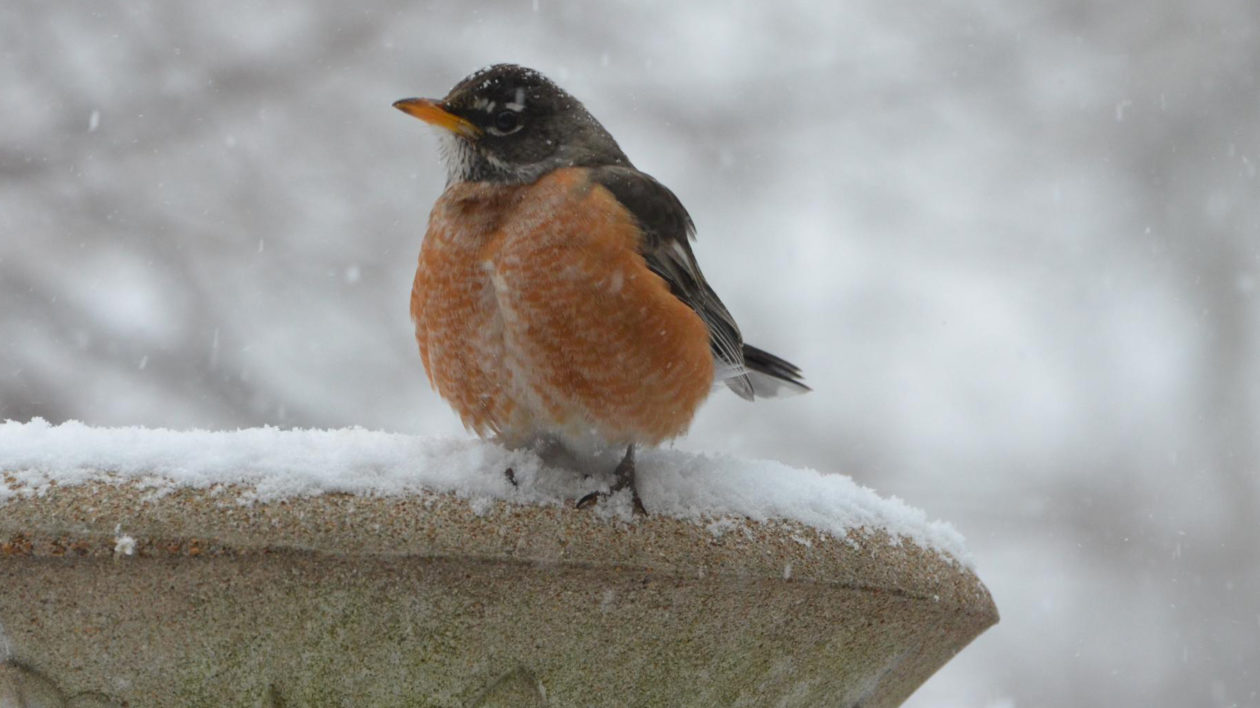
Damn, look at those feathers. I’m wearing the same shade of rust as the robin who is staring me down. She sits fully fluffed in one of the most pathetic trees I’ve ever encountered. They replaced the ancient oaks with scrawny saplings. Our one-street college town needed a facelift.
I’m told the change was anticipated. The trees were old and had to go. “Sickly,” perhaps misidentified by the committee who acts without an arborist to prune away the old wood. I’m bitter this morning.
It’s less than 10 degrees and I’m on my way out. Even through the turtleneck-sweater ensemble, I can feel the wind cut up my sleeve to my bristling Jewish arm hairs. They’re thick, blond, and unruly: standing on end as a chill runs through me.
Why hasn’t this robin flown away? She’s still staring at me, watching the steady approach as my processional inches closer on the unsalted path. Today’s the final biology exam of my undergraduate career, so maybe she’s a sign. A guardian? An omen? It’s not yet spring so she shouldn’t be here.
Robin looks at me, wrapped in her own down jacket: just trying to stay alive. Inside her skin sit hundreds of feathers, nestled in the epidermis but anchored even deeper in the dermis layer of skin. Piloerection is when those feathers rise against the cold, doubling her in size. What a fancy name for goosebumps. I watch as she transforms into a stuffed animal. Too cute to be real.
She stays alive by trapping pockets of warm air in the negative space between her rust-colored ruffle and skin. It’s important that she eats more in the colder months as she supplements her layers with short bouts of exercise. Her cousins flit here, there, across the street, and back again — but she sits, stoically watching me. Her feathers rise involuntarily against the cold as her sympathetic nervous system senses the bitter wind as an invader. It cuts toward her her psyche but is deflected by those rusty warriors of perfectly zippered feathery down.
I have goosebumps too. Neither of us belong here, as far as my grandmother is concerned. She used to teach me that the robins of South Carolina migrated south for the winter and would reappear as the first sign of spring. But that’s only partially true. This is a North American robin and their numbers stretch from coast to coast across America. Their range map is literally the entire continent. She’s probably a local who doesn’t migrate at all. Yet, I pity her.
I migrated north. At the end of my high school career I pushed out of the southeast and expanded my range to the reaches of the midwest where I resettled in Ohio. Only returning to my native foothills for short stayovers, typically in the darkest wintery months.
In my mind, I still associate the first signs of robins with the warming air — so I feel betrayed. What is she doing here? But then again, where do I expect her to go? She has made a life here, no doubt. I see her fluffiness as a clever trick, but it’s really a behavior that evolved over millions of years. We share those goosebumps, her and I.
I stop on the path, I’ll be late to the faculty-sponsored breakfast before my final but I don’t care.
Why have we stopped here, and where shall we go?
 Jesseca Kusher
Leave a comment